Monday, March 23, 2009

KnowMore Hiatus

The KnowMore lectures have begun their four month hiatus.

They will return in August with a new venue and maybe a haircut (unlikely).

Thanks to everyone who attended and shared their feedback.

The next step for the KnowMore lectures is total transparency. I'll be keeping the fun, informal, unpretentious style and adding a discreet layer of quotes from primary sources and recommended readings. In my early days as a teacher it was all about how flashy and funny I was. Now, as I move into phase II, I'm trying to focus on effectiveness. Help people retain information, pursue their interests, and introduce ideas that may inspire them.

In the future, I'll be revisiting lectures, perhaps even breaking up the more ambitious ones into a miniseries.

Tuesday, March 10, 2009

All the Science

Major scientific developments in a nutshell. From teeny subatomic particles to the vast reaches of the universe and all of the gravity, electromagnetism, and theories of relativity in between.

Copernicus, Kepler, Galileo, Newton, Darwin, Faraday, Einstein, and more.

Great ideas explained in a straightforward and fun way. Spreading an understanding of relativity, entropy, evolution, black holes and other fascinating ideas.

Thursday, March 19th, 2009
$5
Unit 102
8pm - 9:30pm

Monday, February 23, 2009

KnowMore Break


There will be no lecture on Thursday, March 5th. I'll be having my wisdom teeth removed.

I will return, less wise, on Thursday, March 19th for All the Science.

Friday, February 6, 2009

WWI and WWII

This is the tale of the war that cast a shadow over human civilization. A time when all of our greatest achievements were unleashed as nightmares. From poison gas to atomic bombs. From scientific racism to civilian bombings. From the assassination of Archduke Franz Ferdinand to the suicide of Adolf Hitler. World War I and World War II are directly connected. Hundreds of years from now it will most likely be remembered as a single narrative of war.

This is a story about glory, empire, invention, and human suffering. It will see Emperors fall, revolutionary visionaries rise, and the unnatural deaths of over 100 million people.

Churchill, Wilson, Truman, Bismarck, Hitler, Stalin, Roosevelt, Mao, Hirohito are all leaders who brought bold answers to the daunting questions of their time.

What started it? What happened? And will awareness prevent it from happening again?

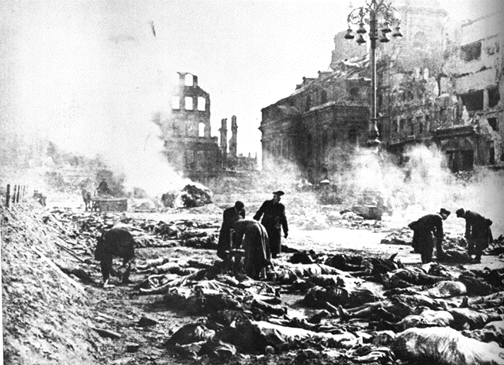
(pictured: the firebombing of Dresden)

WWI and WWII

Thursday, February 19th.
8pm-9:30pm
$5 Unit 102 (46 Noble Street)

I thank you heartily for your mediation which begins to give one hope that all may yet end peacefully. It is technically impossible to stop our military preparation... We are far from wishing war... I put all my trust in Gods mercy and hope in your successful mediation in Vienna for the welfare of our countries and for the peace of Europe.

Your affectionate
Nicky


(excerpt from the Willy-Nicky telegrams July 31st, 1914)

Ancient Greece - Readings

Reading: The Funeral Oration.
"Our government does not copy our neighbors', but is an example to them."

"And, if I am to speak of womanly virtues to those of you who will henceforth be widows, let me sum them up in one short admonition: To a woman not to show more weakness than is natural to her sex is a great glory, and not to be talked about for good or for evil among men."

Pericles' great speech to re-affirm why Athens is at war (from Thucydides' History of the Peloponnesian War).

Reading: The Melian Dialogue.
"... the strong do what they can and the weak suffer what they must."

The Athenian give the Melians a dose of harsh city-state politics. (from Thucydides' History of the Peloponnesian War).

Reading: Socrates' Proposal for his Sentence. (second last section)
"And so he proposes death as the penalty. And what shall I propose on my part, O men of Athens? Clearly that which is my due... I say that maintenance in the Prytaneum is the just return."

The jury expects Socrates to beg that his sentence be reduced from death to exile. Instead, he argues for "maintenance in the Prytaneum*". (from: Plato's Apology).

*The Prytaneum was a public hall where dinners would be held for diplomats and Olympic Champions at the state's expense. Essentially, with his life on the line, Socrates proposes his punishment should be free dinners for life for the service he provides to Athens by asking difficult questions.

Reading: Rhampsinitus and the Thief

"As he spoke, the princess caught at him, but the thief took advantage of the darkness to hold out to her the hand of the corpse. Imagining it to be his own hand, she seized and held it fast; while the thief, leaving it in her grasp, made his escape by the door."

This is the story that amused me. It's a longer tale found a little more than halfway through Book II of Herodotus' The Histories. Search the text for the name Rhampsinitus (from Herodotus: The Histories).

Thursday, February 5, 2009

Ancient Greece - Timeline Handout


Once again, thanks to archive.org, the .pdf handout is available for download.

I had to do the guesswork for the lifespan of some early figures like Homer, Cliesthenes and Pisistratus. The sequence is preserved but there are few reliable dates for Greek history in the 6th Century and beyond.

Thursday, January 29, 2009

Ancient Greece

This is a tale of new ideas, ambition, overconfidence, war, and desperation. Come hear about the rise and fall of Athens, the war that "saved the western world", and the legendary stories (the Odyssey and the Iliad) that inspired the Greeks. You'll also meet a cast of unforgettable characters: the sh*t disturbing Socrates, the dreamer Plato, captivating Pericles, the story-weaving historian Thucydides, brash Alcibiades, and more!

After we cover the five most popular trivia questions about Ancient Greece and the major stories that all scholars must learn we'll discuss the brutal realism of Athenian imperial politics, the details of their limited citizenship and democracy, as well as sex and gender in the ancient world (including same-sex relationships like the Sacred Band of Thebes).

The echoes of the Ancient Greeks continue to resonate in our world. Their spirit was revived during the Renaissance and continues to touch our movies ("This is Sparta!"), government, modern Olympics, architecture, theater, philosophy, and art (pictured: The School of Athens).

Ancient Greece
Thursday, February 5th.
8pm-9:30pm
$5 Unit 102 (46 Noble Street)

"It is from the greatest dangers that the greatest glory is to be won."
Thucydides
History of the Peloponnesian War